
Lucky Gulch / Craps / The craps table layout
The craps table layout
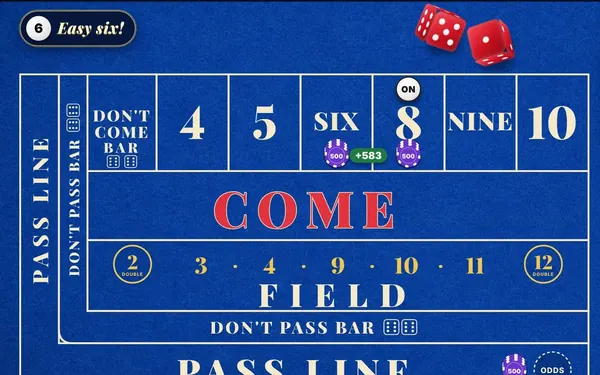
A craps table layout has three parts: the line bets and the Field around the outer edge, the box of numbers across the top (4, 5, 6, 8, 9 and 10) where place bets and come bets sit, and the center, where the hardways and the one-roll bets are. Once you know those three parts, every spot on the felt makes sense.
 See the table up closePlay our craps game100% free. No signup. Just for fun.Roll the dice ▸
One table, two matching ends
A full-size craps table is long, with high walls, and the layout is printed twice, once at each end, so players on both sides can reach their bets. The center bets sit in the middle and are shared. The table here shows one end, with the center bets in a drawer so the layout stays easy to read.
The areas, at a glance
| Area | Where it is | What you bet |
|---|---|---|
| Pass Line | The long strip along the edge | With the shooter: 7 or 11 wins on the come-out |
| Don't Pass Bar | A thinner strip just inside it | Against the shooter: 2 or 3 wins, 12 pushes |
| Come | The big box in the middle of the end | A Pass Line bet that starts on the next roll |
| Don't Come | A small box beside the numbers | A Don't Pass bet that starts on the next roll |
| Field | Between Come and the Pass Line | One roll: 2, 3, 4, 9, 10, 11 or 12 |
| Number boxes | Across the top | Place bets; come bets travel here |
| Center | The middle of the table | Hardways and one-roll bets |
The Pass Line and the Don't Pass bar
The Pass Line wraps around the edge of the layout, so it's the easiest bet to reach. Odds on a Pass Line bet go right behind it, on the felt outside the line. The Don't Pass area is printed "Don't Pass Bar" with a 12 (or a pair of sixes). The bar means a 12 on the come-out doesn't win for the don't side: it's a push. Without that rule the don't side would have the edge over the house. The rules for both.
Come and Don't Come
The Come box is the largest single area on the layout. A come bet works like a Pass Line bet but starts on the next roll, and you can only make it once a point is set. If the next roll is a number, the bet moves from the Come box up to that number's box. How the come bet works.
The Field
The Field lists 2, 3, 4, 9, 10, 11 and 12. It's a one-roll bet: if any of those totals comes up, you win. On this table the 2 and the 12 are circled and pay 2 to 1; the others pay 1 to 1. A 5, 6, 7 or 8 loses. The field bet.
The number boxes
Across the top of the layout is a row of six boxes: 4, 5, 6, 8, 9 and 10, the point numbers. Many layouts spell out SIX and NINE so nobody reads one as the other from across the table. These boxes hold three things: place bets, which win when that number rolls before a 7; come and don't come bets that have traveled to a number; and the puck, when the point is that number.
| Place bet | Pays | $25 wins |
|---|---|---|
| 4 or 10 | 9 to 5 | $45 |
| 5 or 9 | 7 to 5 | $35 |
| 6 or 8 | 7 to 6 | $29 ($150 wins $175) |
The center
The middle of the table holds the proposition bets, also called center bets. The four hardways (hard 4, 6, 8 and 10) win when that number rolls as a pair, like ⚃⚃ for hard 8, before a 7 or the easy way. The one-roll bets win or lose on the very next roll: Any 7, Any Craps, 2, 3, 11, 12 and the horn. They pay the most on the table and cost the most. Here they're all in the CENTER BETS drawer. Horn, hardways and center bets.
The puck
The puck is a round marker with a black OFF side and a white ON side. OFF means the next roll is a come-out. ON, sitting on a number, shows the point. Place bets and hardways are off when the puck is OFF.
The people at a casino table
A full table has a crew of four: two base dealers who handle bets at each end, a stickman who moves the dice with a long stick and calls each roll, and a boxman who sits between the dealers and watches the chips. Players take turns as the shooter. Here the dice are rolled for you; they're random, and every roll is independent.
Big 6 and Big 8
Some layouts have a corner marked Big 6 and Big 8. Those bets win when the 6 or 8 rolls before a 7, like a place bet, but pay only 1 to 1, a 9.09% house edge. A place bet on the 6 or 8 wins on the same rolls and pays 7 to 6, a 1.52% edge. This table has place bets on 6 and 8 and no Big 6 or Big 8.
See every spot in play: how to play walks through a round, and the payouts chart lists what each area pays.
See the table up closePlay our craps game100% free. No signup. Just for fun.Roll the dice ▸
Questions
What do the numbers on a craps table mean?
The 4, 5, 6, 8, 9 and 10 across the top are the point numbers. Place bets and come bets that have moved to a number sit in those boxes, and the puck marks the point there.
What does bar 12 mean on a craps table?
It means a 12 on the come-out roll is a push for Don't Pass and Don't Come bets instead of a win. Your bet stays and nothing is paid.
What does the puck mean in craps?
OFF means the next roll is a come-out. ON, sitting on a number, means that number is the point.
Why does a craps table have two sides?
The layout is printed at both ends of a long table so every player can reach their bets. The center bets in the middle are shared.
Where are the hardways on a craps table?
In the center of the table, with the one-roll bets. On this table they're in the CENTER BETS drawer.
More: How to play craps · Craps rules · Bubble craps · Craps simulator · Crapless craps · Craps strategy · Craps dice odds · Craps payouts chart · Craps bets, explained and ranked · The come bet · The odds bet · Horn, hardways and center bets · The field bet · Iron Cross and 3-Point Molly · Craps terms and lingo