
Lucky Gulch / Pachinko / Vintage pachinko machines
Vintage pachinko machines
Vintage pachinko machines are old Japanese parlor machines, many of them fully mechanical, with a glass-covered board of nails and pockets, a ball tray on the front, and a lever or handle to shoot. They need no screen and often no power, and they still play the way they did in the parlor.
 Now try it yourselfPlay our pachinko machines100% free. No signup. Just for fun.Play pachinko ▸
How to tell how old a machine is
| Feature | What it tells you |
|---|---|
| A lever you flick for each ball | An older mechanical machine |
| A round handle you turn and hold | A later machine that fires on its own |
| Tulip pockets with petals | Common from the 1960s on |
| A center display that spins symbols | 1980 or later, after the Fever machine |
| A video screen in the middle | A modern digital machine |
Until the 1980s, most machines were mechanical. Bells rang for wins, the payout was all springs and levers, and every ball was launched by hand. These are the machines most collectors mean by vintage.
Makers you'll see
Names like Nishijin and Sankyo turn up on many older machines. Sankyo made the Fever machine of 1980, which changed pachinko for good. A maker's name and the board art are the easiest way to identify a machine.
What to check before you buy
- The glass. Look for cracks and chips.
- The nails. Look for bent or missing nails, which change where balls fall.
- The pockets and tulips. Tulips should open and close cleanly.
- The payout. Drop a ball in a pocket by hand and make sure balls pay out to the tray.
- The launcher. The lever or handle should fire balls smoothly up the rail.
- The back. Open it up. Rust, missing parts or loose springs mean repair work.
- Balls. Make sure you'll have enough 11 mm steel balls to fill the machine. More on pachinko balls.
- Power. Later machines with lights, sound or a display need electricity and the right power supply.
Restoring one
Most restoration is cleaning: the glass, the board, the balls and the payout mechanism. Parts like springs and tulips wear out. Straighten nails carefully, since the board was laid out so balls bounce a certain way. The Masamura gauge layout from 1948, with its windmills and pockets set so a ball that misses one can find another, is part of what makes an old board fun to watch.
How a vintage machine plays
On a mechanical machine, every ball that lands in a pocket pays balls straight back to the tray. There's no center screen and no draw: what you see is the whole game. Load the top tray, flick or turn, and watch the balls bounce. How pachinko machines work.
The modern version
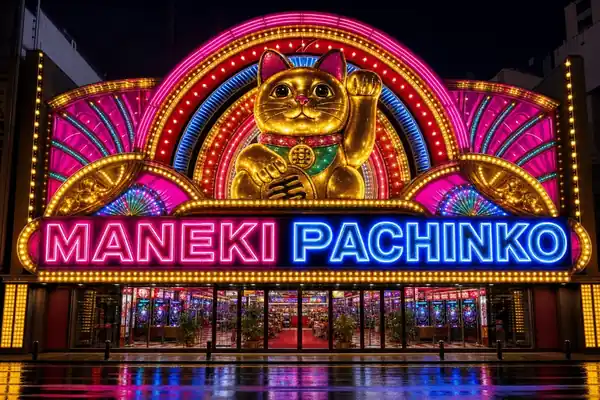
Today's parlor machines add a video screen, a jackpot draw and big bonus rounds. Kitsune vs Tengu in Maneki Pachinko plays in that style, in your browser with play money, no signup and no download. What is pachinko?
Now try it yourselfPlay our pachinko machines100% free. No signup. Just for fun.Play pachinko ▸
Questions
How do I know how old my pachinko machine is?
Look at the launcher and the center. A lever you flick for each ball means an older mechanical machine. A spinning symbol display in the middle means 1980 or later.
Do vintage pachinko machines need electricity?
Many fully mechanical machines don't. Later ones with lights, sound or a display do.
What size balls does a pachinko machine use?
11 mm steel balls, the size set for Japanese parlor machines.
Who made vintage pachinko machines?
Many Japanese makers. Nishijin and Sankyo are names you'll see on many older machines.
Can I play pachinko without buying a machine?
Yes. Maneki Pachinko is a free pachinko hall in your browser with play money, just for fun.
More: What is pachinko? · How to play pachinko · How pachinko machines work · Pachinko parlors in Japan · Is pachinko gambling? · Pachinko vs pachislot · Pachinko balls · Maneki-neko, the lucky cat · Gachapon machines, Japan's capsule toys · Japanese good luck charms · Kitsune and tengu